
Membrane Technology
MBR Membrane Types, Materials & Selection
Select an MBR membrane system by separating three linked decisions—material, module geometry, and process integration—then validating the resulting package against actual wastewater, treatment objectives, maintainability, and the applicable OEM envelope.
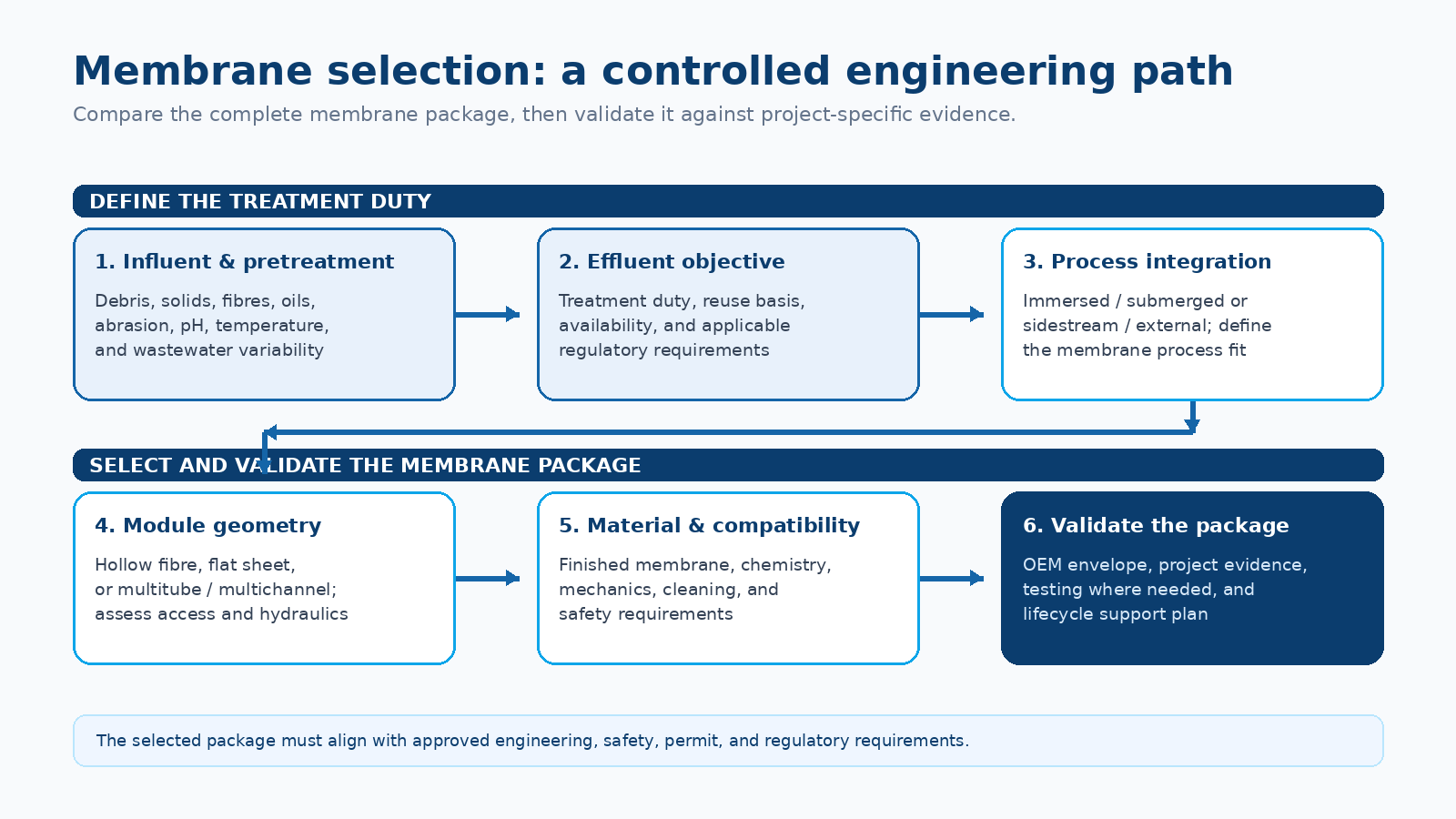
Start by separating the three design decisions
MBR membrane terminology can become confusing when material, module geometry, and process configuration are treated as the same decision. They are related, but each answers a different engineering question. A membrane is a perm-selective barrier: water passes through while suspended material is retained. Its selectivity and throughput are influenced by the active layer and support structure, while its operating behaviour also depends on mixed liquor, pretreatment, air or crossflow shear, and the full module design. [1] [2]
| Decision layer | What it defines | Questions to answer first |
|---|---|---|
| Material and surface | The active filtration layer and supporting structure, including their chemical, thermal, mechanical, and surface-affinity properties. | What cleaning, temperature, pH, solids, oils, abrasives, and handling conditions must the installed membrane tolerate? |
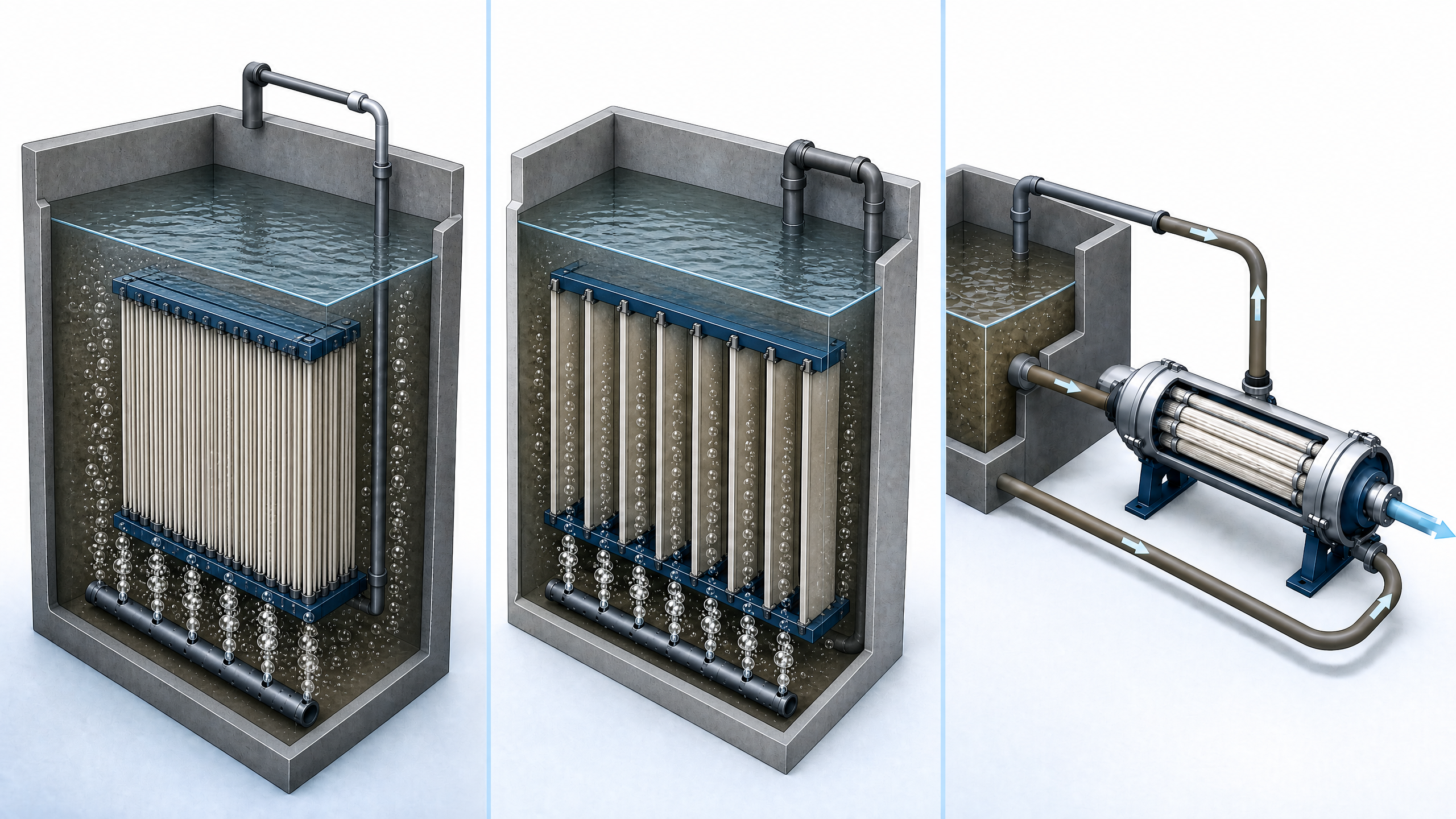
| Module geometry | How the membrane area is packaged: hollow fibre, flat sheet/plate, or multitube/multichannel. | What pretreatment robustness, access, replacement approach, packing density, and scouring or crossflow arrangement fit the plant? |
| Process integration | How the module is connected to the biological process: immersed/submerged or sidestream/external. | Can the system manage fouling with air scour in a membrane tank, or does the wastewater/process duty call for a pumped crossflow loop? |
Membrane material families
Polymeric membranes are well established in MBR applications, while ceramic membranes may be considered where the wastewater or cleaning environment places unusual demands on the membrane package. Composite and surface-modified membranes use a selective surface and supporting structure to balance separation, mechanical stability, and surface behaviour. Material is important, but it is only one part of the installed system. [3] [4]
| Material family | Examples | Useful selection discussion | Validation boundary |
|---|---|---|---|
| Polymeric | PVDF, PES, PSf, PAN, PE, PP, PTFE and related polymer families. | Polymeric membranes can be manufactured into common MBR geometries and have well-established applications. PVDF is widely represented in MBR products; other polymers and blends are also used. | Do not infer chemical tolerance, wetting, fibre strength, cleaning compatibility, or expected life from polymer name alone; verify the actual module data and approved procedure. |
| Ceramic | Alumina, titania, zirconia, silica, silicon carbide and other inorganic formulations. | Ceramic systems may be evaluated where chemical, thermal, abrasion, or industrial-duty considerations are important, typically with a different module and lifecycle package. | Capital, installation, brittleness, geometry, pumping, cleaning, and lifecycle implications remain application and vendor dependent. |
| Composite or modified surface | A selective skin with porous support; coatings, blending, grafting, or other surface modification approaches. | Surface-affinity and support-layer design can influence fouling behaviour and mechanical stability, so evaluate the finished membrane rather than only the base polymer. | Claims of antifouling performance require wastewater-representative evidence and do not remove the need for pretreatment, monitoring, or approved cleaning. |
Which membrane materials fit which wastewater duties?
The table below is a screening guide for application discussions, not a material guarantee. Wastewater category alone is insufficient: temperature, pH, oxidants, solvents, oils, abrasives, fibres, toxicity, cleaning chemistry, and the supplier's validated operating envelope must be checked for the exact membrane and module. Polymeric systems are widely used across municipal and many industrial applications, while ceramic systems may become more attractive when thermal, chemical, abrasion, or cleaning demands are unusually severe. [1] [4]
| Wastewater or industry | Polymeric membrane suitability | Ceramic or inorganic suitability | Checks before selection |
|---|---|---|---|
| Municipal sewage and domestic wastewater | Common starting point for submerged hollow-fibre or flat-sheet systems where influent is well screened and the chemical/temperature range is conventional. | Technically possible, but the durability premium must be justified by site conditions, cleaning strategy, service-life assumptions, or a special reuse duty. | Screening, ragging risk, seasonal temperature, ammonia/nutrient objectives, air-scour demand, permeability recovery, and membrane replacement plan. |
| Hotels, resorts, schools, offices, and decentralized/package plants | Often attractive where compact submerged equipment, low operator burden, packaged replacement, and established supplier support are priorities. | May suit harsh or high-temperature source streams, but module weight, lifting, service access, and capital cost can be disproportionate for small plants. | Occupancy variability, shock loading, intermittent operation, storage/equalisation, operator skill, remote maintenance, and spare-module availability. |
| Food and beverage, dairy, and brewery wastewater | Can be suitable after equalisation, fat/oil control, solids management, and confirmation that cleaning and temperature conditions remain within the polymer/module envelope. | May be considered where hot streams, aggressive cleaning, high organic loading, or abrasive solids create a strong lifecycle case for inorganic construction. | Fats, oils and grease, proteins, sugars, cleaning-in-place chemicals, temperature excursions, salinity, foaming, and biomass rheology. |
| Textile, chemical, pharmaceutical, and specialty manufacturing wastewater | Potentially suitable only after chemical compatibility and toxicity review; polymer swelling, oxidation, solvent exposure, and irreversible fouling risks require product-specific evidence. | Can be attractive for selected harsh chemical or thermal duties, but ceramic compatibility is not universal and the complete module, seals, supports, and cleaning system must be checked. | Compound inventory, solvents, oxidants, dyes, inhibitory substances, pH excursions, temperature, batch discharge, and treatability/pilot evidence. |
| Landfill leachate and high-strength industrial wastewater | Possible with robust pretreatment and equalisation, but high fouling potential, refractory organics, salinity, and chemical exposure can narrow the operating envelope. | May be worth evaluating where high solids, difficult cleaning, abrasion, or aggressive chemistry make durability and cleanability more valuable than minimum CAPEX. | Ammonia, humics, salinity, metals, scaling, viscosity, suspended solids, gas formation, concentrate/waste handling, and realistic cleaning recovery. |
| Oily, abrasive, or particulate-rich wastewater | Requires strong pretreatment and confirmed resistance to the actual oil, surfactant, and abrasive mixture; do not infer suitability from polymer family name. | May offer a stronger mechanical and cleaning basis in selected duties, but larger passages, pretreatment, seals, and abrasion management remain essential. | Oil droplet size, emulsions, grit, fibres, metal fines, ragging, abrasion, screening, coalescing or flotation pretreatment, and module inspection access. |
Surface affinity, structure, and compatibility
Many filtration membranes have a thin selective layer supported by a more open porous structure. Surface water affinity can influence adsorption and fouling interactions, but it cannot be assessed independently from the wastewater matrix, biomass condition, module hydrodynamics, and cleaning regime. A material that appears attractive in a laboratory comparison may behave differently in a full-scale MBR when exposed to soluble microbial products, extracellular polymeric substances, oils, surfactants, scaling ions, oxidants, or repeated cleaning. [1] [2]
| Property to review | Why it matters in an MBR | Evidence to request |
|---|---|---|
| Surface affinity and roughness | Can influence adsorption, cake formation, wetting, and permeability recovery, but the effect depends on the actual mixed liquor. | Wastewater-representative performance data rather than a generic contact-angle or clean-water claim. |
| Support and selective-layer structure | Affects mechanical strength, hydraulic resistance, defect sensitivity, and how the membrane responds to pressure, relaxation, backwash, or air scour. | Module construction details, integrity-test method, allowable operating range, and validated cleaning procedure. |
| Chemical compatibility | pH, oxidants, acids, alkalis, solvents, oils, temperature, and cleaning concentration can affect the membrane, seals, potting, headers, and support frame differently. | Current OEM compatibility matrix and approved chemical-cleaning limits for the complete module. |
| Mechanical and thermal durability | Handling, vibration, air-scour hydrodynamics, abrasion, thermal cycling, and module lifting can affect service life even when the membrane chemistry is compatible. | Reference installations, replacement records, module-handling instructions, and whole-life assumptions. |
For selection purposes, treat material data as a basis for comparison rather than a guarantee of fouling resistance or service life. The finished membrane–module–process package must be checked against pretreatment, biological operation, air or crossflow shear, approved cleaning, integrity monitoring, and the project’s maintenance capability.
Hollow fibre versus flat sheet: when should each be shortlisted?
Hollow fibre and flat-sheet membranes are both established MBR module families, but they package membrane area and manage mixed liquor differently. The comparison below is a screening tool, not a universal ranking. The selected membrane, cassette or bundle, air-scour arrangement, pretreatment, flux, cleaning programme, integrity controls, and supplier reference data must be assessed as one package. [10] [11]
| Decision factor | Hollow fibre | Flat sheet / flat plate |
|---|---|---|
| Typical integration | Commonly immersed in bundles with supplier-specific air scour, relaxation, backwash, or pulsing. | Predominantly immersed in cassettes with planar channels and defined cassette-level air distribution. |
| Membrane-area density | Often higher, which may support a compact membrane tank. | Often lower for the same tank volume, potentially requiring more cassette or tank space. |
| Initial selection signal | Investigate first when footprint is constrained, fine screening is reliable, and compact installed area is important. | Investigate first when cassette access, defined lifting/replacement units, and an immersed layout are valued. |
| Fouling-control focus | Fibre movement, air-scour distribution, bundle condition, and approved backwash or pulsing. | Plate-channel hydraulics, air-scour coverage, solids passage, cassette inspection, and cleaning recovery. |
| Integrity management | Fibre breakage, bundle and manifold condition, and leak or integrity testing. | Plate elements, seals, headers, cassette isolation, and module-level integrity testing. |
| Typical application signal | Large municipal, decentralized, reuse, and selected industrial plants where compactness and validated fibre operation matter. | Municipal, decentralized, resort, institutional, reuse, and selected industrial plants where cassette access and immersed operation are attractive. |
| Do not assume | Higher packing density automatically means lower whole-life cost or better fouling resistance. | Planar geometry automatically tolerates poor pretreatment or eliminates fouling and cleaning requirements. |
Practical decision table
| Project condition | Initial configuration to investigate | Reason and validation boundary |
|---|---|---|
| Large flow, compact site, reliable fine screening, and strong membrane-air-scour design | Hollow fibre | High area density may reduce membrane-tank volume; validate air demand, fibre integrity, cleaning, and whole-life cost. |
| Owner prioritises cassette access, lifting, inspection, and defined replacement units | Flat sheet | Planar cassettes may provide a clearer physical maintenance strategy; verify wet weight, crane access, and tank volume. |
| Remote resort, institutional, or package plant with variable occupancy | Compare both | Alarm response, minimum water level, cleaning logistics, local service, and intermittent loading may matter more than geometry. |
| Industrial wastewater with fibres, sticky solids, oil, toxicity, or unusual chemistry | Do not choose by geometry alone | Pretreatment, equalisation, chemical compatibility, pilot/reference data, and cleaning recovery should define the shortlist. |
| Very high solids, abrasive duty, or strong need for external access and pumped cross-flow | Compare tubular/sidestream as well | Larger passages and external access may be valuable; compare pump energy, wear, footprint, and cleaning. |
| Reuse project with demanding availability and integrity requirements | Compare both using validated references | Integrity monitoring, downstream disinfection/polishing, redundancy, and regulatory validation remain separate requirements. |
Module geometry and process configuration
Flat sheet, hollow fibre, and multitube/multichannel are the commonly discussed MBR module families. Immersed and sidestream describe the process arrangement, not the membrane material. In immersed systems, modules sit in the membrane tank and surface shear is commonly provided by aeration. In sidestream systems, mixed liquor is circulated through external membrane equipment and crossflow contributes to surface shear. [5] [3]
| Module or process family | How to recognise it | Design and O&M discussion | Do not assume |
|---|---|---|---|
| Hollow fibre | Bundles of fine fibres, commonly in immersed cassettes. | Assess packing, pretreatment robustness, air-scour distribution, physical-cleaning method, fibre handling, access, and integrity approach as one package. | Do not assume every hollow-fibre system has the same backwash method, screening requirement, flux, cleaning cycle, or damage tolerance. |
| Flat sheet or plate | Planar sheets or plates arranged as panels, usually immersed. | Assess cassette arrangement, channel clearance, air-scour path, physical cleaning, solids behaviour, access, and replacement process in the proposed tank layout. | Do not assume a flat sheet is automatically immune to clogging, simpler to operate, or suitable for any influent without verified pretreatment. |
| Multitube or multichannel | Multiple flow channels, often associated with external/sidestream arrangements. | Assess crossflow pumping, hydraulic losses, solids/viscosity, accessible cleaning, abrasion, temperature, and industrial wastewater variability. | Do not assume a tubular geometry alone justifies higher pressure, higher flux, or a specific chemical-cleaning programme. |
| Immersed / submerged | Membranes are in the membrane tank; permeate is withdrawn through the module. | Evaluate membrane-tank layout, air-scour delivery, duty/standby strategy, permeate hydraulics, accessibility, and the biological process interface. | Do not treat the configuration as a guarantee of low energy or low fouling; performance depends on the full design and operation. |
| Sidestream / external | Mixed liquor circulates through external membrane equipment and returns to the biological system. | Evaluate pumping duty, crossflow hydrodynamics, module access, isolation, cleaning logistics, footprint, and process control. | Do not treat external access as a substitute for safe isolation, compatible cleaning, or an approved maintenance procedure. |
Which industries suit immersed or sidestream MBRs?
Immersed and sidestream describe how the membrane process is integrated with the biological system. Immersed modules sit in a membrane tank and commonly use air scouring for membrane-surface shear; sidestream systems circulate mixed liquor through external membrane modules and rely more directly on pumped cross-flow and hydraulic turbulence. The choice affects energy, footprint, access, pretreatment, controls, maintenance, and the way the plant responds to variable wastewater. [5] [7]
| Wastewater or industry | Immersed / submerged process is often attractive when… | Sidestream / external process is often attractive when… | Primary trade-off to examine |
|---|---|---|---|
| Municipal wastewater and large community plants | Compact footprint, lower membrane-side pumping demand, integrated biological treatment, and established air-scour operation are important. | A higher-flux or externally accessible arrangement is justified by the design basis, available pumping energy, or a special process requirement. | Air-scour energy, membrane-tank volume, train redundancy, access, and whole-life cost rather than membrane flux alone. |
| Decentralized, remote, resort, and package plants | Low equipment count, compact packaged construction, and simple integration with an aerobic bioreactor are priorities. | External access and isolation are more valuable than minimum equipment count, and trained operators or service support are available. | Operator capability, remote alarm response, spare strategy, cleaning logistics, and intermittent or highly variable occupancy. |
| Food, beverage, and dairy facilities | Equalised wastewater is compatible with submerged operation and the plant values compactness and reduced external pumping. | Higher solids, viscosity, temperature, cleaning frequency, or external inspection needs justify a pumped loop and accessible membrane equipment. | Fouling and viscosity, grease control, cleaning downtime, pump wear, process heat, and production-schedule constraints. |
| Textile, chemical, pharmaceutical, and specialty manufacturing | The wastewater is sufficiently characterised, toxicity is controlled, and the selected module has validated air-scour and cleaning performance. | External isolation, controlled cross-flow, staged treatment, and easier access are important for variable or chemically challenging feeds. | Compatibility, toxicity, temperature, solvents, membrane cleaning, materials of construction, and the risk of transferring a laboratory result directly to full scale. |
| High-strength, abrasive, or difficult industrial wastewater | Only when pretreatment and equalisation reduce the duty to a range the submerged module can reliably handle. | Often worth evaluating where larger flow passages, high cross-flow, external access, and cleanability are central to the process concept. | Recirculation-pump energy and wear versus membrane-tank aeration, pretreatment, module replacement, and maintainability. |
| Water reuse and high-quality effluent projects | Suitable when the immersed membrane package meets the validated permeability, integrity, availability, and downstream polishing requirements. | Suitable when external access, staged membrane barriers, or special process control provides a stronger validated risk-management basis. | Membrane configuration is only one barrier; integrity monitoring, disinfection, polishing, validation, and regulatory requirements remain separate. |
Read the process table as a screening tool
These are application tendencies, not rules that assign one process configuration to an entire industry. A municipal plant with severe industrial trade waste may need the same pretreatment and cross-flow analysis as an industrial plant, while a well-equalised food wastewater may be successfully treated in an immersed package system. The defensible choice comes from the wastewater matrix, the required availability, validated module data, energy balance, cleaning and integrity procedures, and the site's ability to operate and maintain the complete package.
A controlled selection framework
The right selection is not a material ranking. It is a traceable comparison between the treatment duty and the complete membrane system. Start with what the wastewater and project require, then use vendor data, reference installations, and validation work to challenge the proposed solution. The supplier reference provided for this revision usefully highlights the need to consider materials, configurations, operation, and lifecycle together; those points have been corroborated here with specialist and peer-reviewed sources. [6]
| Selection stage | Evidence to compile | Decision output |
|---|---|---|
| 1. Define the duty | Influent variability; solids, fibres, oils, abrasives, salinity, temperature, pH, shock-load history; target discharge or reuse objective; required availability. | A documented wastewater and treated-water basis for assessing technology fit. |
| 2. Confirm pretreatment | Screening and grit arrangement, protection against debris/ragging, equalisation where relevant, and evidence that the upstream arrangement fits the selected module. | A protection basis that is evaluated with—not after—the membrane choice. |
| 3. Compare the complete package | Material, module geometry, integration arrangement, air or crossflow approach, permeate system, physical and chemical cleaning philosophy, space, access, and isolation. | Comparable system options rather than an isolated material choice. |
| 4. Check compatibility and integrity | OEM compatibility envelope, approved cleaning and safety procedures, integrity-monitoring approach, module handling/replacement plan, and spares/service support. | A maintainable system with defined operational ownership. |
| 5. Validate and document | Relevant reference data, representative testing or pilot work where uncertainty is material, lifecycle and replacement assumptions, and applicable regulatory/permit review. | A project decision record that can be reviewed and updated as conditions change. |
What this guide does not replace
Use the proposed membrane supplier’s current data sheets and approved procedures for material-specific chemical compatibility, physical-cleaning routines, allowable operating ranges, installation, module handling, integrity testing, and warranty requirements. Confirm any reuse or pathogen-removal claim against the applicable jurisdiction and project validation. Where mixed liquor, industrial variability, or cleaning risk is unusual, obtain appropriate pilot, bench, or specialist engineering review before procurement.
Continue the membrane technology workflow
After establishing a material and configuration shortlist, use Fouling Mechanisms, Monitoring & Prevention to assess interactions with biomass and operating conditions. Use Membrane Cleaning: CEB, CIP, Soaking & Recovery for evidence-led response boundaries, and Membrane Integrity & Module Management for integrity, handling, and lifecycle records.
Sources and revision note
This guide is an educational engineering reference prepared from public technical literature, specialist guidance, OEM material, and the supplied industry reference. It does not replace project-specific engineering, an approved plant procedure, membrane manufacturer instructions, safety requirements, or permit conditions. Last reviewed: August 27, 2026.
- The MBR Site, Membrane materials used in MBR technology: polymeric.
- Iorhemen, Hamza & Tay (2016), Membrane Bioreactor Technology for Wastewater Treatment and Reclamation: Membrane Fouling.
- The MBR Site, MBR materials and configurations.
- The MBR Site, Membrane materials used in MBR technology: ceramic.
- The MBR Site, Membrane separation process configurations in MBRs.
- Nihao Water, MBR Membrane: The Ultimate Guide to Wastewater Treatment.
- DuPont, Membrane Bioreactor (MBR).